
Tennessee Busted Mugshots
A mugshot is taken during jail intake. The photo is just one step in a longer process. Tennessee's standard booking procedure also gathers fingerprints, an arrest report, and a warrant or capias bearing a state control number before final disposition processing. So a photo can exist even when a county posts nothing on its public site.
One arrest creates records in several offices. Police keep the incident report. The jail holds the booking record, custody status, and intake photo. Each custodian controls a different slice. A court clerk takes the case result later. A separate state system covers people who enter TDOC custody or supervision after a felony case.
Start with the county named on the booking. Check that county's official roster first. Use a records request when no public entry turns up. Some show photos and some do not. A missing name proves little. The person may have been released, moved, booked in another county, or left off the feed by policy.
Booking is the intake step that follows an arrest. It records the event. Charges can shift, end in dismissal, or change again, so confirm the court disposition before calling a case resolved.
Tennessee Booking Record Fields
The state procedure lists records booking should create. Not every county website displays the same fields, though. One jail may post a bare roster card while the records custodian keeps the fuller booking record. Ask the office that made it for a defined record. A name alone can fail. People share names.
| Record field | What it can show |
|---|---|
| Identity and booking number | Name and the jail's event or booking identifier, when the local system displays it. |
| Booking date and agency | Intake timing and the police or sheriff agency that brought the person to the jail. |
| Charges as booked | The charge recorded at intake. It is not a verdict and may differ from the filed court charge. |
| Warrant or capias | A court process may be recorded with a state control number as part of standardized booking. |
| Photograph and fingerprints | Booking identification materials. The image may be withheld online or released only after review. |
| Bond and release | When supplied by the county system, the amount or status tied to release from that jail. |
| Disposition processing | Final case information sent through the required reporting workflow, not a live public roster field in every county. |
| TDOC profile fields | For state felony custody or supervision, FOIL may show a photo, TDOC ID, SID, aliases, status, location, sentence, and release information. |
Some county portals show arresting officer, city, charges, bond, and release fields beside the image. Others show only a name. Some list a recent booking window. A missing field online does not mean it was never recorded. Say what you want. A request should name the booking card, arrest report, photograph, fingerprints, or court filing.
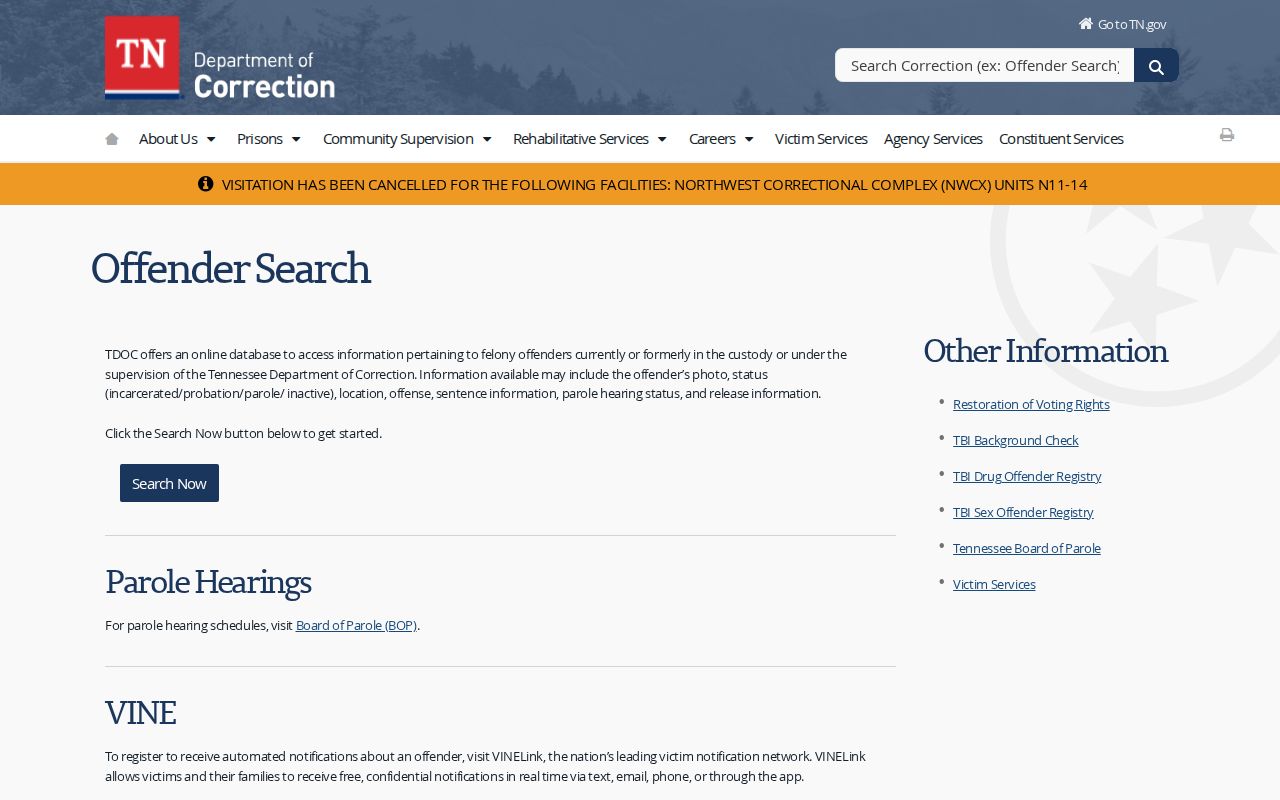
State prison adds another layer. FOIL covers felony offenders now or formerly in TDOC custody or supervision. Its profile may show an offender-system photo. It may say "No Photo Available." It is not a search for every misdemeanor, citation, pretrial detainee, or county arrest.
Note: Tennessee booking records can be split among police, jail, and court custodians, so name both the record and the agency you need.
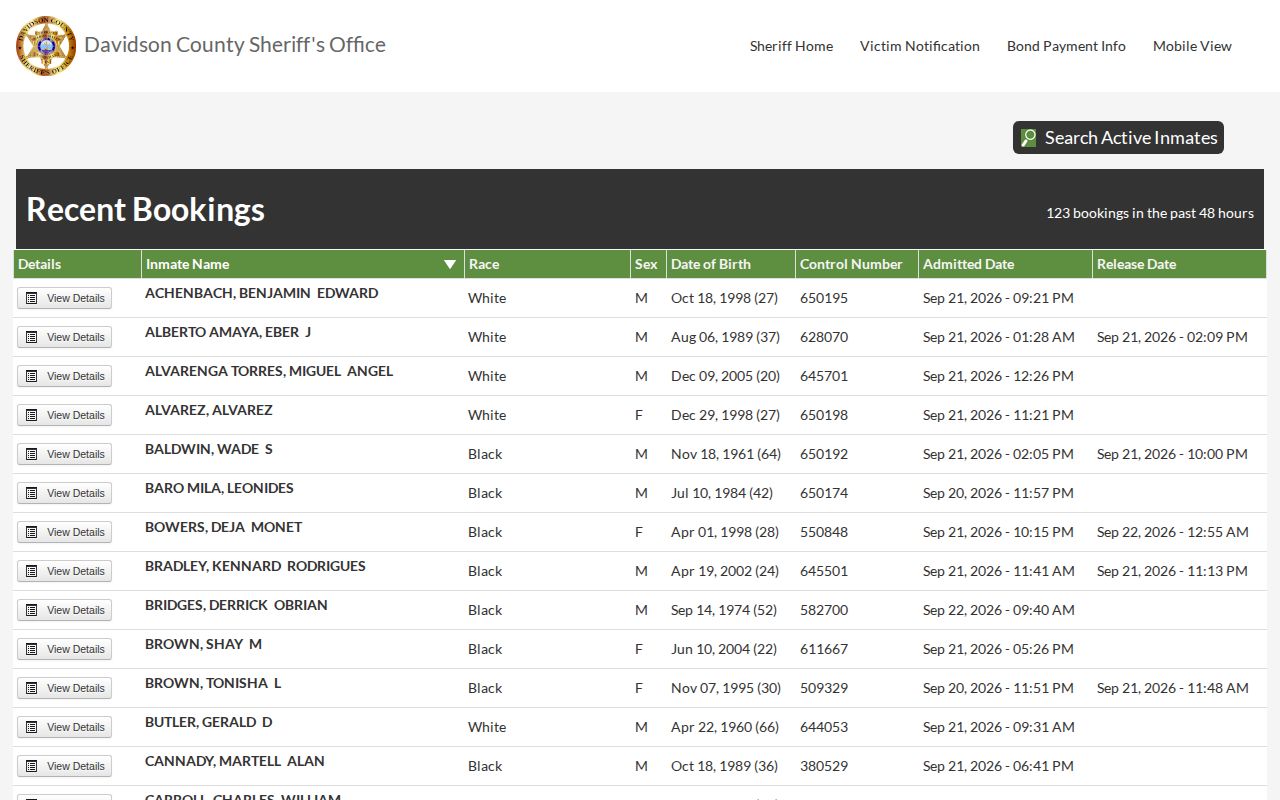
The Davidson County Sheriff's recent-bookings search shows one county's own booking interface. It is local, not statewide.
Tennessee Mugshot Law
Tennessee's law is not a rule that every sheriff must post every booking photo online. The research located no enacted statewide statute that makes every publisher remove a booking photo, bans publishers from charging for removal, or gives everyone one free takedown process. The relevant rules instead come from public-record access, booking procedure, confidentiality limits, court records, agency policy, and an expungement order when a person qualifies.
The Tennessee Public Records Act gives Tennessee citizens a right to inspect public records held by state and local government, subject to exceptions. The Comptroller's guidance treats photographs and electronic data as records too. A custodian must have a public-records policy and a coordinator, and a request must describe a record well enough for staff to find it. Access can still be limited by another law, a court rule, an order, or a protected-information rule such as T.C.A. § 10-7-504.
Separate Tennessee statutes restrict juvenile photographs and court-file access. A photo made in a government system is not automatically a public web image. The custodian decides whether an exception, redaction, or court order applies.
The General Assembly subject index shows the status of the 2021 proposals. It is useful legislative history, but it is not an enacted removal law.
The proposed 2021 Stop Guilt by Accusation Act would have set rules for media outlets after certain favorable outcomes and proposed removal duties. The official bill status shows that the measures did not become an enacted Tennessee Code provision. A proposal is legislative history, not a current duty. For a fuller explanation of the law, court outcomes, and correction paths, use the Tennessee mugshot-law page.
Note: Public access means a record may be inspectable under law, not that a sheriff must publish it on a searchable web page.
Requesting Tennessee Booking Records
Skip the web roster and ask the office that holds the record. The county sheriff or jail keeps the booking card and photo. The arresting police department holds the incident report. A court clerk keeps the filings and case result. Ask for an existing record. No office has to build a statewide list or decide what happened in a case.
- Identify the arrest county and likely custodian. If the booking happened after a city arrest, the city may have the incident report while the county jail holds the intake record.
- Give the person's full name or known booking number, a date range, the record type, and the agency. Ask for inspection first if that will help identify the right copy.
- Use the custodian's public-records coordinator and form. The state's model records-request form can help frame the request, but each county or city sets its own process.
- Ask for any lawful copy or labor estimate before proceeding. There is no single statewide fee or response time in the research for every sheriff, jail, or city department.
The Comptroller's TPRA FAQ explains inspection and copies. A custodian can redact protected parts. If a request is denied, keep the written response. Ask which statute or policy applies. The County Directory routes a request to the local site for that county, where the official records path can be checked.
TDOC runs a separate route for archived departmental files. Give enough detail to locate the record. That search covers TDOC files, not the county jail's original booking photo.
For current TDOC records, use the department's Media and Records Requests process. TDOC wants sections 1 through 4 of its inspection and duplication form, filed under policy 216.01. The archived-records page asks for contact details, full name, TOMIS number, date of birth, and a detailed description. Archive searches may carry a charge. Do not send payment at first.
Retention and website display are two different things. The CTAS sheriff schedule sets five-year retention for inmate census and booking logs. Inmate registers and jail shift reports are permanent. Identification files with photos and fingerprints fall under a long-term rule. Counties can adopt local schedules and different formats. A released person vanishing from an inmate page does not mean the record was destroyed.
The model schedule names 12-003 Arrest Records/Case Files, 12-009 Identification Files, 12-010 Inmate Census/Booking Logs, 12-015 Inmate Registers, and 12-017(b) Jail Shift Reports. Five-year, permanent, and long-term rules depend on each series. A county records coordinator can confirm the local schedule.
Expungement depends on the case result and offense. TBI says it is not automatic. Qualifying routes include acquittal, dismissal, nolle prosequi, no true bill, reversal, or successful diversion when the statute allows. Certain eligible convictions carry five- and ten-year waiting periods after sentence requirements are met, under T.C.A. § 40-32-107. You need the signed court order. Confirm it reached the arresting agency, jail, TDOC, and TBI as applicable.
An official order changes how custodians handle a record. It does not delete private copies or social posts at once. Once the source agency acts, send the order through each publisher's free correction route. A search-engine refresh can follow.
TBI's expungement guidance describes the outcome-based routes and says qualifying orders must be processed. The Tennessee mugshot-law page links to the current agency instructions.
Note: Confirm an order's effect with the court and custodians; online copies can persist after an official record changes.
Finding Tennessee Busted Mugshots
Match the tool to the question. A jail roster shows who sits in county custody now, and booking records can linger after release. Court files show the case result later. FOIL covers felony offenders in TDOC custody or under supervision, and no single search reaches every county, court, federal inmate, or immigration detainee in Tennessee.
- Start with the county where the arrest and booking took place. Search the sheriff or jail site for a current roster, recent bookings, or inmate search.
- Check the page's date window and custody label. A same-day feed may drop a person after release, while a longer window may include people who are no longer held.
- If no public result appears, ask the county records coordinator for the booking record and photo. The public window may be short, or the county may not provide an online feed.
- If the person was sentenced to state custody or is on TDOC supervision, search FOIL. A county booking does not mean the person is in TDOC.
- For a case outcome, check the trial-court clerk in the county. The statewide Public Case History portal covers appellate cases, not every county criminal docket.
Start with the TDOC mugshot search page for the state-prison layer. FOIL is that offender-photo layer. A county roster is the booking layer. A TDOC ID or SID can narrow a state search fast. A name alone proves neither identity nor custody. Wanted lists call for care. Never approach anyone over an old post, since a stale listing is not a live warrant. Check status with the agency or court, ask counsel about resolving a warrant, and see the Most Wanted Fugitives page for the official lists and safe tip routes.
The FOIL search form displays the name fields and identifiers Tennessee state-offender lookups use.
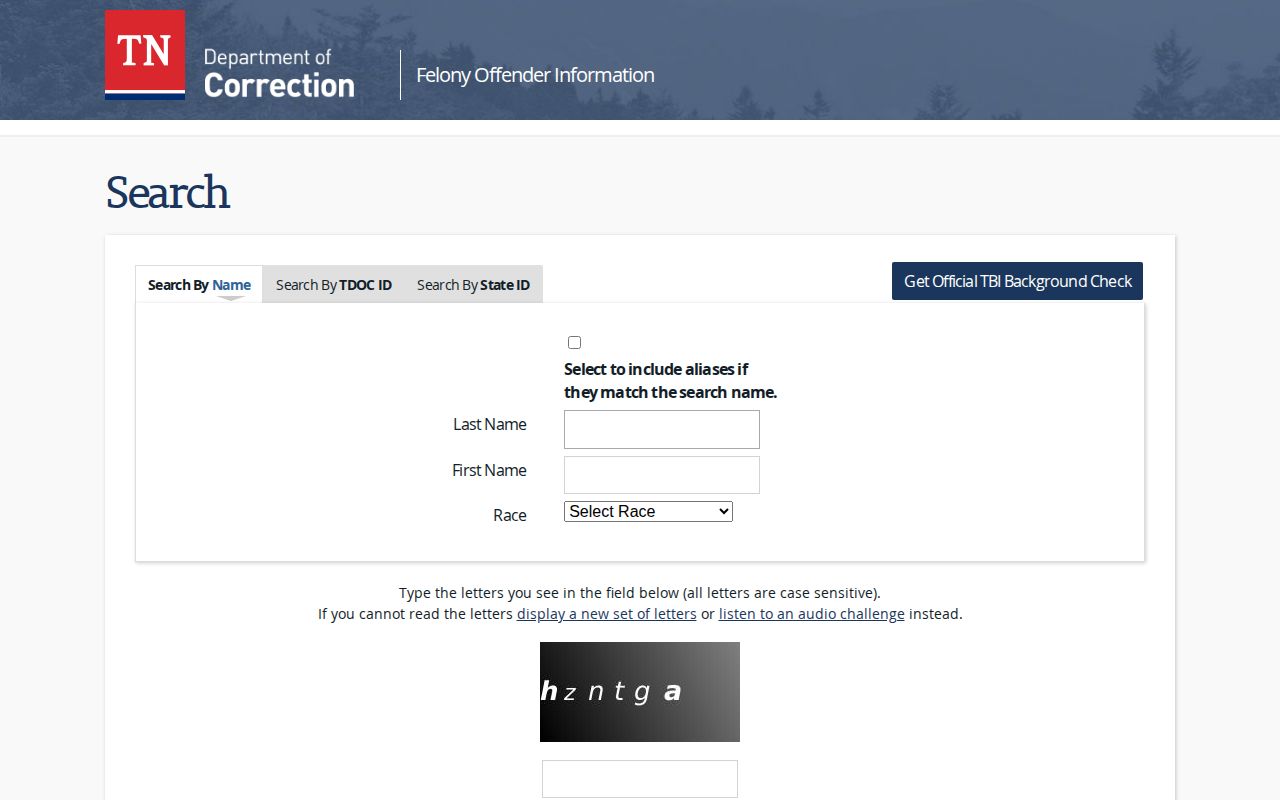
Open a matching profile only after checking its identifiers. Some show a photo; some say “No Photo Available.” Status and sentence fields sit alongside. TDOC promises no refresh interval. It also promises no photo for every former offender. Where should a search begin if the county is unknown? No county name to start with? Hunt for the arresting agency on a court paper, release notice, or similar official record. If city police made the arrest, the county jail may still hold the booking record. The County Directory is arranged by county. That means the search can move to the right local custodian.
Tennessee Busted Roster and Feed Patterns
No single statewide county-booking feed exists in Tennessee. The state standardizes intake; each sheriff picks the public view. That choice produces variety. County systems range from vendor portals to name searches, recent-booking pages, dated PDFs, apps, social posts, and direct records requests. These records are not equal. A roster lists current inmates, a recent-arrest page may list people already released, and a PDF may cover only a fixed date range. Anderson's ISOMS portal is a good example. It offers 24-, 48-, 72-, and 168-hour views. Photo cards there carry arresting agency, city, release, charge, and bond fields. Davidson County posts recent bookings plus person and advanced searches. Hamblen and Wilson add recent-hour filters. Wilson sits behind a human-check screen, so photos there stay hard to confirm. Carter, Sevier, and Sullivan show searchable roster details, while Hardeman and Washington post booking reports or intake summaries. More interfaces fill out the map. Bradley runs JailTracker, Fayette uses a Zuercher inmate search, and Montgomery offers public inquiry and recent-arrest routes. Shelby has an inmate search. Southern Software powers Decatur and Monroe. Dyer links a booking-report endpoint. Obion keeps an in-house inmates page, and White links a BlueHorse inmate page. Some of these routes show photos, some never promise one, and a card without an image does not mean the jail took no photo. Links change, so treat each county's official page as the road to the live service.
Tennessee's Comptroller guidance on public records covers your right to inspect photos and electronic files.
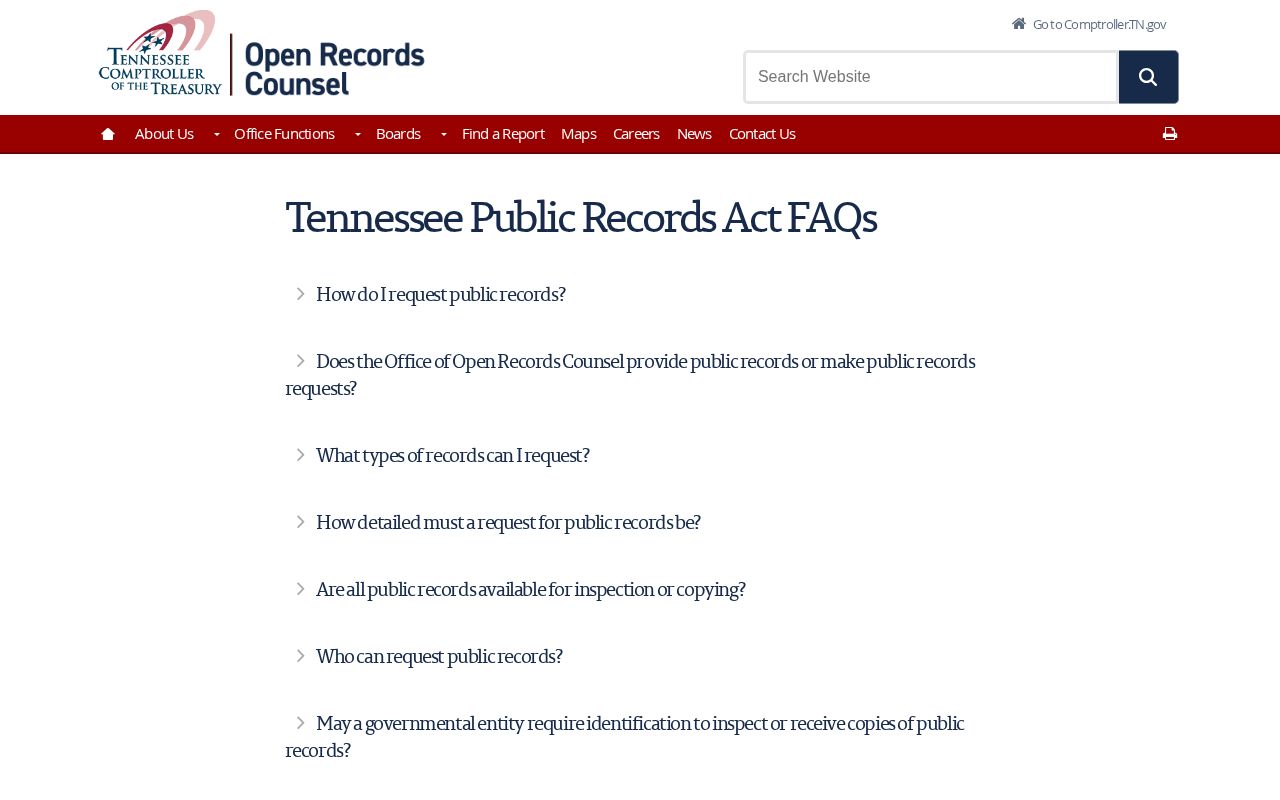
Photo cards appear openly in several sheriff systems. Elsewhere the behavior is conditional. Zuercher, BlueHorse, Shelby, Washington, and Wilson do not guarantee a public photo view. Many rural counties offer no public feed at all. That gap is about the interface. It does not mean the county lacks a booking system, or that a record cannot be requested. Big systems often offer a public search or release control. Small counties lean on a limited vendor screen, a dated report, an app, or a records unit. Either way, an intake record still exists. The directory points to the county that made the booking, where current filters and access rules can be checked. Note: A missing image may reflect a county's interface or release rule, not the absence of a booking photo.
Tennessee Busted Booking Alerts
A sheriff app can help track custody or release. It is still a separate product from the roster. App and Mobile Patrol patterns appear in Anderson, Cocke, Crockett, Decatur, Giles, Grundy, Hamilton, Obion, Rutherford, and Union, among others. Large systems split the two jobs. The official Hamilton booking app information shows how booking alerts sit apart from the full list. Washington's intake page and summary PDF chart another route. Never assume an app matches the website's search fields or saves old photos. An alert can report a release. It is not the permanent booking record. Confirm the app is linked by the county sheriff, and check its current features there. If an entry is missing, use the official roster or make a records request.
Tennessee Busted Jail Statistics
Each month the Tennessee Department of Correction posts Jail Summary Reports, built from counts that sheriffs and jail administrators file. It is a snapshot. The tally comes at month's end. Names and booking photos never appear. So the table gives a broad view of local custody across the state, yet it cannot prove that any one person was arrested or let go.
That aggregate number is not an arrest log. A booking feed works at the event level. Depending on county policy, it can list a name, booking date, charge label, bond, and release status. A summary shows who was held on a reporting date, not who came or went during the month. For that level of detail, turn to a county roster or a request to the records custodian.
None of this measures Tennessee mugshots online. County portals leave photos out, shrink the public window, or require a records request. The two record types answer different questions. Intake procedure is one thing; statistics are another.
Note: Jail population totals describe custody on a reporting date, not bookings made during that month.
Tennessee Court and Warrant Search
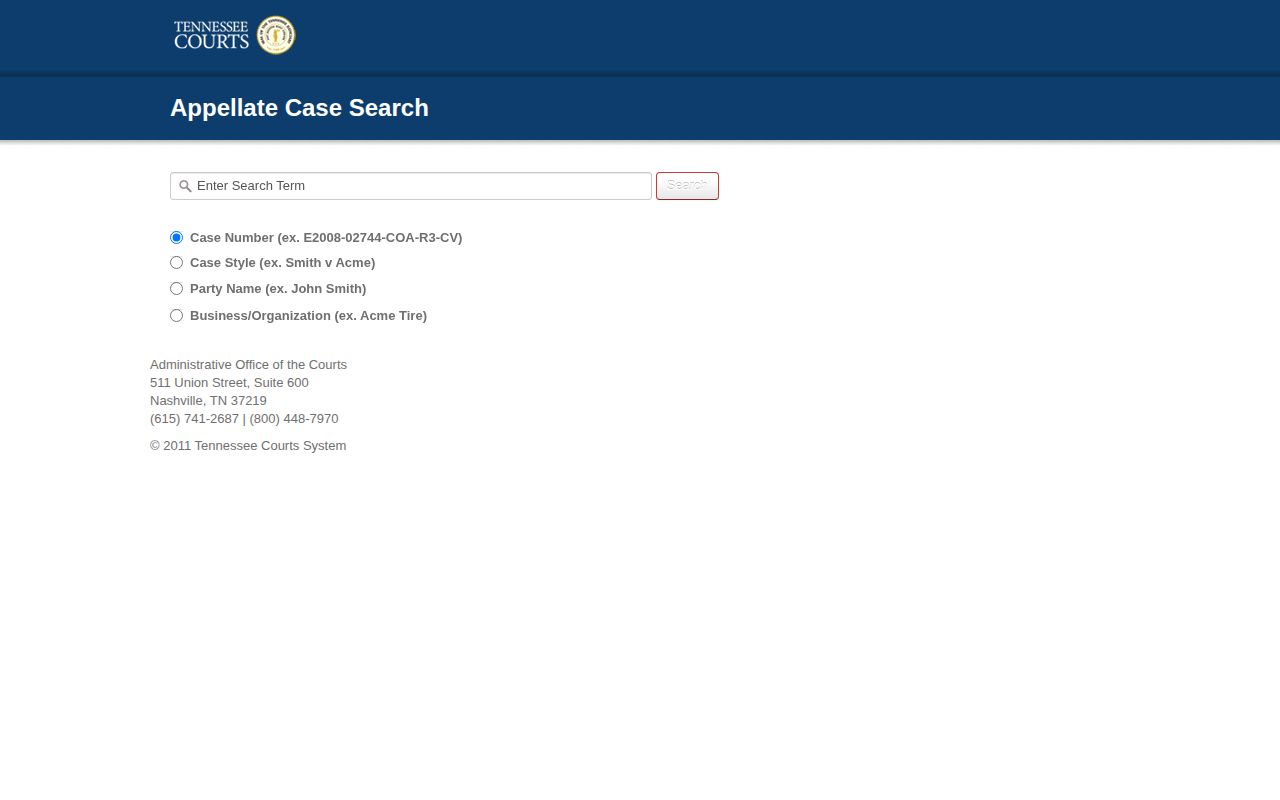
Court records answer a different question: what happened after the booking. Tennessee's Public Case History system covers appellate cases. You can search it by case number, case style, party name, or organization. It runs through the prior business day. It is not a statewide trial-court booking index. A no-match there does not rule out a county arrest.
The Tennessee Public Case History portal describes its appellate search fields and scope.
Supreme Court Rule 34 gives Tennessee court records a presumption of public access, though exceptions apply. Warrants need a different route. Find the issuing county first, then verify status with that court or the sheriff's warrants office. A charge can end many ways: dismissed, resolved by a plea, acquitted, or sentenced. Wanted-list posts age badly. They can be incomplete.
Statewide wanted systems sit apart from county warrant lookups. The TBI's Top Ten Most Wanted page profiles a chosen few, with photos, names, and charges. Rewards appear when offered. TDOC news runs absconder alerts. No single stable public TDOC absconder roster exists. U.S. Marshals profiles track federal fugitives across Tennessee's three districts. The official lists and tip paths are gathered on the Most Wanted Fugitives page.
Tennessee Records Across Custody
Custody status changes the source you need. Rosters drop people after release. Yet the booking record stays with the jail. A state offender profile covers a later felony custody or supervision stage, while federal and immigration systems run separately.
| Record stage | Useful official source | What it can answer |
|---|---|---|
| New or current county booking | Arresting agency and county sheriff or jail | Booking status, local booking fields, and whether a photo is shown under that county's policy. |
| Released from county jail | County records coordinator and court clerk | Existing booking record, releasable photo, filings, and disposition. Release from a roster does not end record retention. |
| TDOC custody or supervision | TDOC FOIL | Felony offender profile, possible photo, status, sentence, location, and release fields. |
| Federal custody | BOP locator and federal court | Federal inmate custody information. The public BOP locator does not provide a public booking-photo feature. |
| Immigration custody | ICE Online Detainee Locator | Current ICE custody or certain recent CBP custody, using the exact identifiers required by ICE. |
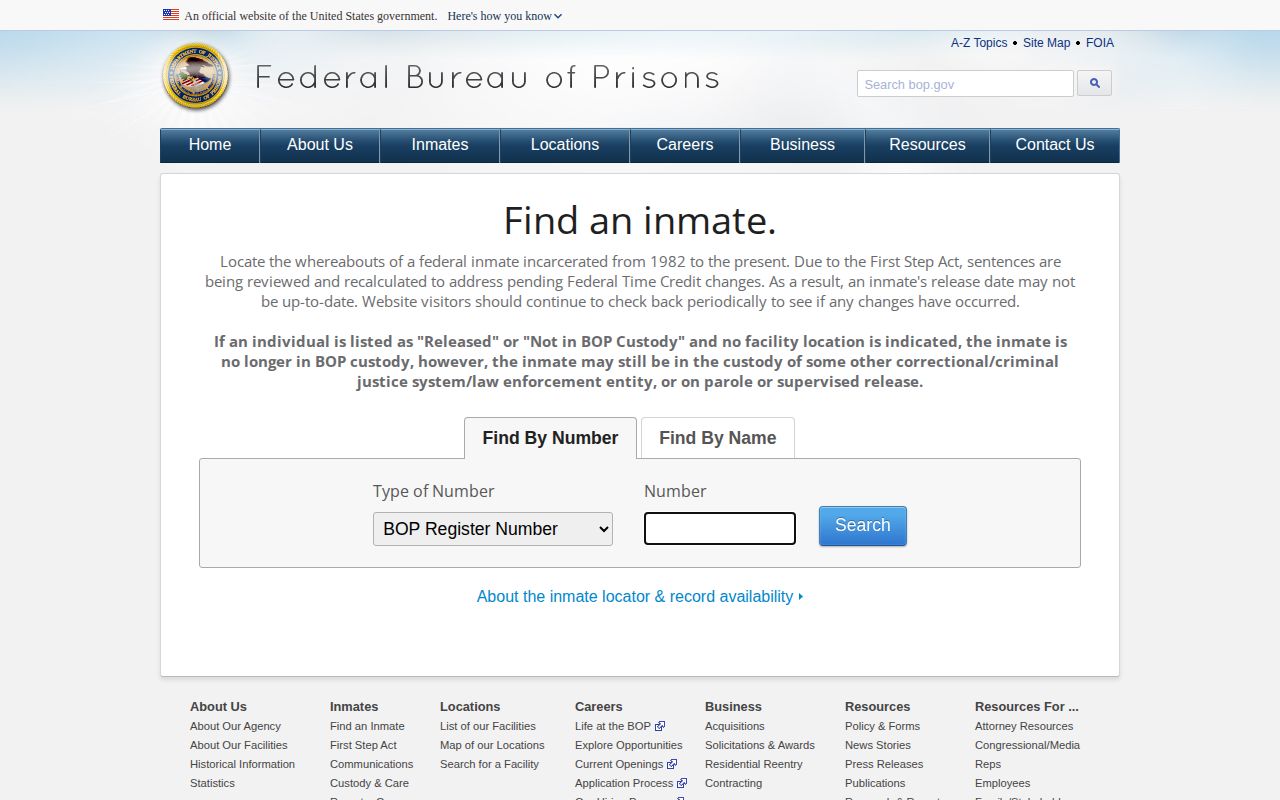
Federal prison looks different. The BOP locator searches inmates by name or register number, reaching back to 1982. It returns identifying and custody fields. No public booking photo comes with it. The ICE Online Detainee Locator takes an exact nine-digit A-number plus country of birth, or an exact name with both country and date of birth. It skips anyone under eighteen, and neither tool is a county mugshot feed.
The TDOC Offender Search page explains its FOIL role.
The BOP inmate locator handles federal custody searches.
Tennessee Busted Mugshot Sources
Start with official county and state systems, not copied listings. Third-party pages can hold onto a date, charge label, or image. That copy lingers long after the source roster changes. They may miss a later dismissal. They may also attach the wrong person's record. None confirms current custody or a final court result.
| Source | Record layer | Photo or status limits |
|---|---|---|
| County sheriff or jail | Current custody and recent bookings | Official source. Some counties show photos; others limit the window or require a records request. |
| Arresting police department | Incident or arrest report | May hold the police report while the county jail holds booking and custody details. |
| County court clerk and Tennessee Public Case History | Trial filings or appellate cases | Use the trial clerk for local criminal outcomes. The statewide portal covers appeals and does not show every booking. |
| TDOC FOIL | Felony custody or supervision | May display an offender photo; it does not cover every county arrest. |
| BOP or ICE locator | Federal prison or immigration custody | Separate custody systems. BOP has no public booking-photo feature, and ICE is not a county roster. |
| News outlets | Selected reported events | Photos may be booking images, court papers, surveillance images, or portraits. Coverage is selective. |
| Third-party publishers | Copied booking or arrest material | Unofficial and sometimes stale. Check the originating agency and court before relying on a label. |
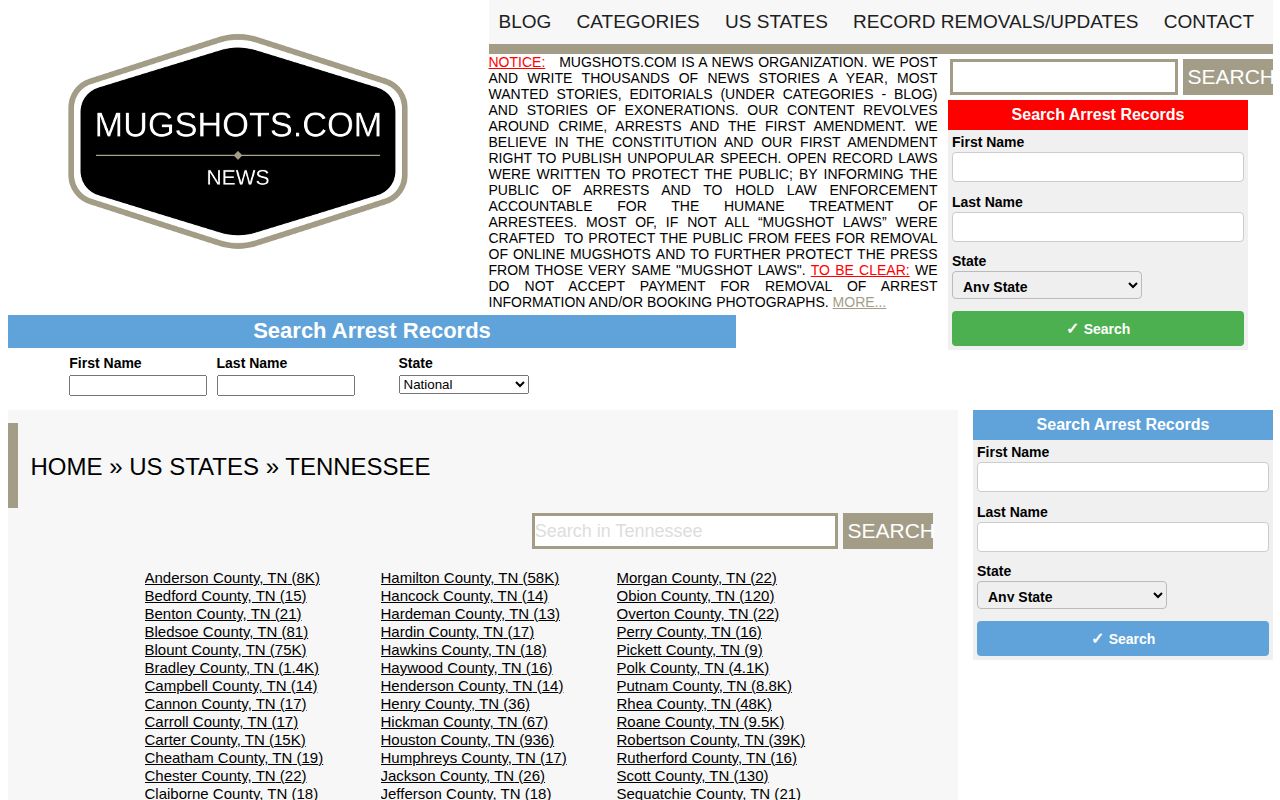
BustedNewspaper, RecentlyBooked, Mugshots.com, Arrests.org, and the Mugshots Zone network all run Tennessee pages as secondary indexes. Coverage varies widely. RecentlyBooked keeps a 30-day window. BustedNewspaper says its coverage tracks source feeds. Mugshots.com county totals can mix in older copies, Arrests.org offers a selected county menu, and Mugshots Zone routes through a shifting network directory. Treat their labels as publisher text, then verify each fact with the sheriff or clerk.
Mugshots.com's Tennessee index shows a publisher's county organization, not a live jail roster.
News outlets pick their arrest stories selectively. WBBJ runs dated Madison County mugshot galleries. Memphis, Nashville, and East Tennessee stations do too, sometimes. A news image can be a booking photo, an affidavit page, a surveillance still, or a portrait. Follow the source link, since those types are not interchangeable, and find the disposition.
The Mugshots Zone network home is a third-party county directory whose coverage can change.
Use a free correction route when a publisher offers one. Attach an official court order or corrected record. Keep a copy of the request. Skip paid removal intermediaries. Search engines refresh only after the source page changes, and they cannot scrub copies elsewhere, so the reliable path stays county roster, custodian request, court disposition, then lawful correction.