
Where Old Tennessee Mugshots Live
No single statewide image archive holds historical booking photos. Booking is the jail's intake step after an arrest. Staff log identity and case details. So the first question is which agency made the record. A sheriff or jail created county intake material. A state prison built inmate records after someone entered the penitentiary system. The court clerk holds the case outcome. It may explain a later sealing or expungement order. Even one arrest can leave its paper split across three offices. A finding aid from the Tennessee State Library and Archives maps state-prison records. It covers Record Group 25 from 1831 through 1992. County searches run a different route. Ask the sheriff or jail records coordinator first. Turn to the county clerk or archivist if the sheriff no longer holds the file. A local retention schedule can show a series or transfer path. No source here promises a modern booking photo was kept, scanned, or made public. For recent entries, try the statewide Tennessee arrest and booking record search. It helps identify the right kind of source. Then route to a county through the County Directory. An old roster card is not the case file. The court disposition tells how the charge actually ended. The clerk's office is where that answer sits.
Tennessee State Prison Record Group 25
TSLA's Record Group 25 is the core statewide path for historic prison research. Its finding aid covers Tennessee State Penitentiary material from 1831 into the later twentieth century. The group holds inmate records and indexes. There are discharges and grade books too. Staff and visitor material sits in the collection. So do records from DeBerry Correctional Institute. Think of it as a map to a collection. It is not a searchable list of every arrest. No guarantee comes with each inmate file that a photo waits inside. The finding aid warns that parts of the collection hold restricted confidential records. Access depends on the record type. A catalog entry may still leave you needing staff help to reach a box or learn whether a file can be viewed. An old state-prison record can also say little about the county booking itself. The local jail may have kept a separate intake record that never joined the prison collection.
| Collection or record | What it covers | Access path |
|---|---|---|
| TSLA Record Group 25 | State-prison records, 1831 to 1992, including inmate files, indexes, discharges, and institutional records. | Read the finding aid, then ask TSLA about the relevant series and access limits. |
| Published penitentiary indexes | Names and selected inmate details for 1831 to 1870. | Search the online volumes or request a staff search for the indexed years. |
| County jail series | Local identification files, booking counts, registers, and jail reports. | Ask the county custodian for the local retention schedule and series label. |
The long span aids historical inmate research. But the boundaries matter. State penitentiary records are not a county arrest report. Inmate files can exist while mugshot books for a given year do not survive. Note: An archival description shows what a collection may hold; the archivist must confirm whether a named file exists and can be released.
Tennessee Penitentiary Indexes, 1831 to 1870
TSLA has posted penitentiary indexes covering two spans. The 1831 to 1850 volume comes first. The 1851 to 1870 volumes continue the run. Both volumes can be searched by name at the archive's site. An entry may list name, year, race, age, crime, and county. These are historical inmate indexes. Treat an entry as a pointer, not a booking-photo database or proof of a modern county arrest. For an index search covering 1831 to 1870, TSLA says readers may email reference.tsla@tn.gov. Material after 1870 requires a written request. The published-index search and copy charge is $5. A post-1870 search costs $10. Copy and certification charges may also apply. For a post-1870 search, send a person's name and a five-year range. TSLA gives an approximate two-week response target for many requests. The TSLA request and fee page lists these charges and instructions, so check it before sending money or documents. Researcher help runs through the reference contact route. That includes ask@tsla.libanswers.com and 615-741-2764. A narrow date span helps staff separate people with similar names. If the year is uncertain, give a reasoned range plus the county or other details from the index. Use the published volumes to find a likely name and year. Then ask TSLA what the entry points to. Do not assume a photo is attached. These penitentiary records can identify a historical entry without holding an image or the case file behind it. Note: The two-week estimate covers many requests, not every search, copy order, restricted file, or complex question.
Tennessee Jail Records and Retention
Counties keep their own files, but a statewide model points you to the right shelf. The CTAS Sheriff's Records Retention Schedule lists record series. These are groups of records that share a type or purpose. Naming a series in a records request can steer it toward the correct file. Series 12-009, Identification Files, may hold fingerprints, photographs, measurements, and physical descriptions. Booking logs and inmate census records fall under Series 12-010. Series 12-015 covers jail and inmate registers. Three more series round out the set: 12-003 Arrest Records or Case Files, 12-005 case files, and 12-017(b) jail shift reports.
Retention periods differ by series. Inmate census records carry a five-year period under the model. Registers and jail shift reports, though, are kept permanently. Identification files stay on file until death or a reasonable presumption of it. The schedule puts that at 100 years after birth. Its own conditions and microfilm rules are attached. Counties run on local schedules and systems of their own. So treat these periods as a guide to the listed series. They are not a promise that every county holds identical files. Nor do they promise that every old photograph is still within reach.
| CTAS series | Record type | Retention information in the model |
|---|---|---|
| 12-003 and 12-005 | Arrest records or case files; other case files | Ask for the county's adopted schedule for the applicable series. |
| 12-009 | Identification file, including photographs and identifying details | Until death or a reasonable presumption of death, described as 100 years after birth, subject to schedule terms. |
| 12-010 | Inmate census and booking log | Five years. |
| 12-015 | Inmate or jail register | Permanent retention. |
| 12-017(b) | Jail shift report | Permanent retention. |
A permanent register can outlive its public image. A vendor's card may vanish after release, yet the record itself can still sit in a paper file, a local database, or on microfilm. The reverse happens too. A photo may sit in the system while another part of the file is withheld. When you write to a county, ask for its adopted schedule and name the series, date range, and record type. Skip the vague plea for all old mugshots.
Requesting Older Tennessee Records
Start with the event, then follow the record to its custodian. Give the full name first. Add the approximate booking or prison dates, the county, the arresting agency, and any case or booking number you already hold. Then ask pointed questions. Does the office have the record, which series applies, is the photo releasable, and was it moved to another office? A blank search result proves nothing about destruction.
- Ask the sheriff or jail records coordinator for the historical booking record and photo, using the county and date range to identify the event.
- Ask the county clerk for the case disposition and any sealing or expungement order. A roster entry is not a court outcome.
- Ask the county archivist or clerk whether the record moved to a local archive, paper series, microfilm, or another custodian.
- For state-prison records, search the TSLA finding aid and indexes, then use the request method that matches the year and record series.
- Review the fee estimate and any redaction or confidentiality notice before requesting copies or certification.
What survives may differ from what appears online. A county register can be permanent. Its public roster card may be long gone, and an old image can sit restricted, missing, or held apart from the court file.
Different offices can hold the pieces. A request may also end in inspection rather than a free copy. Copy, labor, search, and certification charges can apply under the custodian's rules. If an office denies any part, keep the response. Ask which statute or schedule supports the restriction. That paper trail helps with any appeal.
Note: Send only the identifiers needed to find the record, and route sensitive personal details through the custodian's official request channel.
TDOC Archive Requests Have a Different Scope
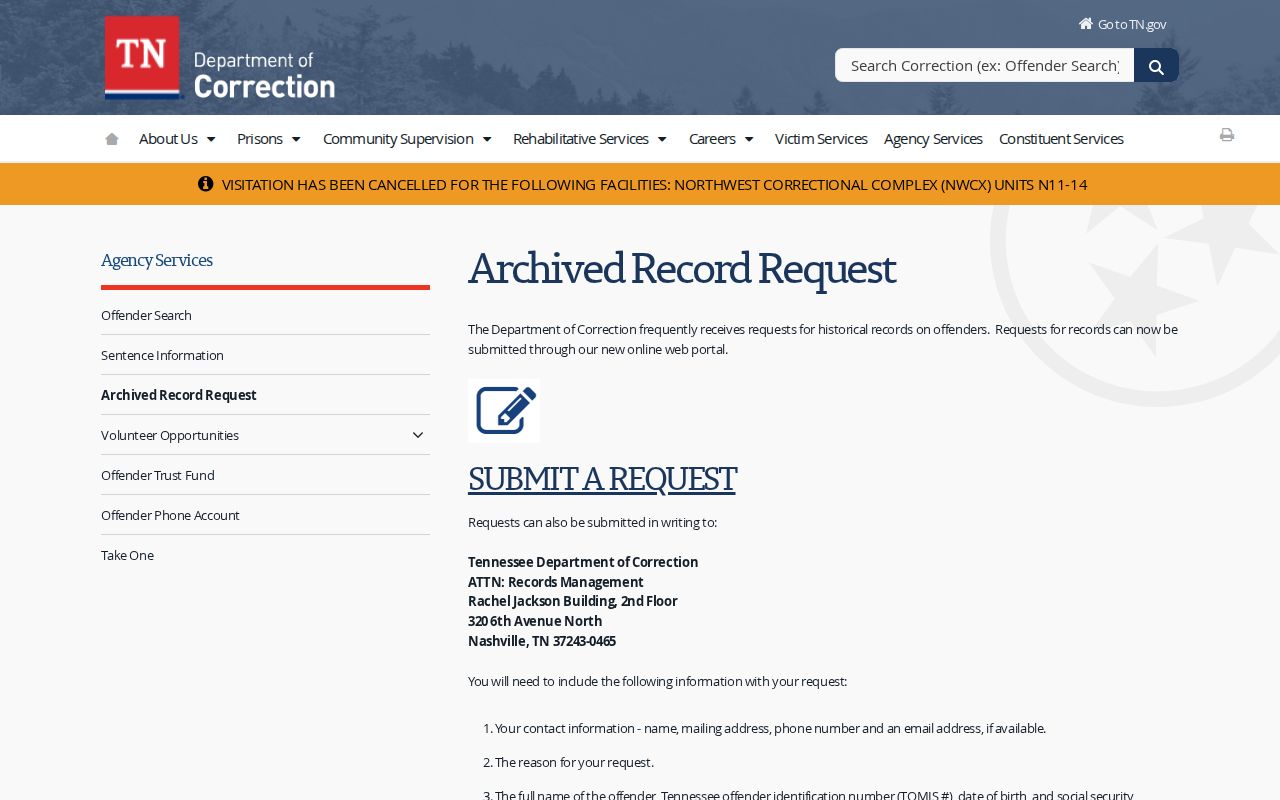
A historic state-prison file and an archived Tennessee Department of Correction record are related paths, but they are not one collection. Know which one you need. TDOC's Archived Record Request page covers older records the department itself created. The portal sits online. Written requests go to TDOC Records Management. The form wants real detail. Expect contact information, the person's full name, TOMIS number, date of birth, and a detailed description. TOMIS is the identifier used in TDOC's offender system. TDOC warns that an archive search may carry a charge, and it says not to send payment at the start. The TDOC Archived Record Request page marks this separate agency route, so use it only when the record truly belongs to TDOC, not for a county jail's original booking photo.
Where you start depends on what you seek. A county booking begins with the county custodian. A historic penitentiary index begins with TSLA, and an older TDOC file goes to TDOC Records Management. The real distinction is who owns the record, not its age. Age changes nothing. A decades-old county booking never turns into a TDOC record just because time passes. Nor can a state-prison search stand in for the county's original arrest file. So match the request to the holding agency.